
Description
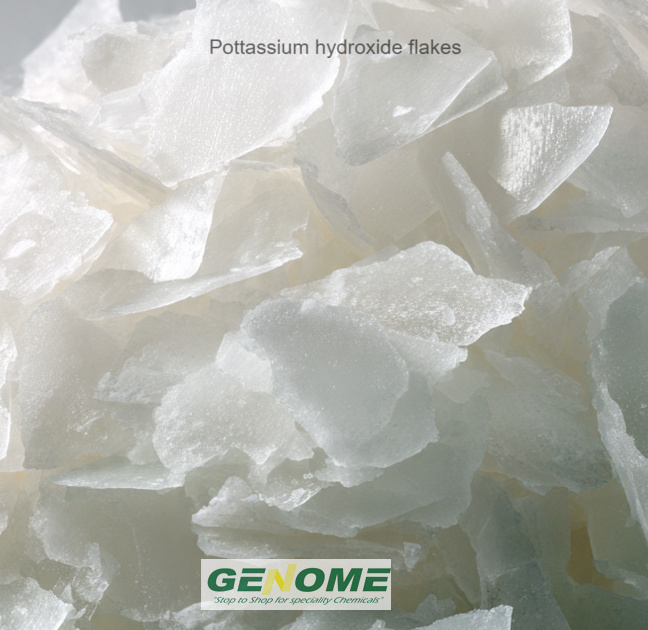
KOH flakes, or potassium hydroxide flakes, are a white, odorless, solid form of the chemical compound potassium hydroxide (KOH). It’s a strong, highly corrosive alkaline base commonly known as caustic potash or potassium lye.
Key Properties
| Property | Details |
|---|---|
| Chemical Formula | KOH |
| Chemical Name | Potassium Hydroxide |
| Form | Dry, solid flakes |
| Purity | Typically ≥ 90% (reagent grade) |
| Molecular Weight | 56.11 g/mol |
| Solubility in Water | Highly soluble (≈1120 g/L) |
| pH (aqueous | ~13.5 (strongly basic) |
Uses and Applications
KOH flakes are used in many different industries:
Soap Manufacturing: They are a primary ingredient in making soft or liquid soaps through a chemical reaction called saponification.
Cleaning Products: The strong caustic nature of KOH makes it effective in drain cleaners, oven cleaners, and industrial cleaning agents for removing grease and organic residues.
Biodiesel Production: KOH acts as a catalyst in the transesterification process that converts vegetable oils and animal fats into biodiesel.
Alkaline Batteries: A solution of potassium hydroxide is used as the electrolyte in alkaline batteries because it is more conductive than sodium hydroxide.
Agriculture: It’s used in liquid fertilizers and to adjust the pH of acidic soil.
Food Industry: KOH is a food additive (E525) used as a stabilizer, thickener, and pH control agent.
Common grades of KOH:
Technical / Industrial Grade
This is the most widely produced grade of potassium hydroxide. It has a high level of purity, but a less strict specification on trace impurities compared to other grades.Purity: Typically 85% to 90% KOH, with the remainder being mostly water and a small amount of potassium carbonate (K2CO3), a common byproduct of its reaction with atmospheric carbon dioxide.Physical Form: Available in solid forms such as flakes, pellets, or briquettes, and also as a concentrated liquid solution (e.g., 45% or 50% concentration).
Applications: Used in large-scale industrial processes where the presence of minor impurities is not a significant issue.
Soap Manufacturing: A key ingredient in the production of soft and liquid soaps.
Detergents & Cleaners: Used in industrial cleaners, drain openers, and degreasers.
Fertilizers: A source of potassium for liquid fertilizers.
Chemical Manufacturing: A raw material for producing a variety of other potassium compounds.
Petroleum Refining: Used in petroleum refining to remove organic acids and sulfur compounds.
Food Grade (FCC)This grade meets the stringent purity requirements of the Food Chemicals Codex (FCC), making it safe for use in food processing.Purity: Must have a high assay of KOH and very low levels of impurities, especially heavy metals like arsenic and lead.Physical Form: Available as solid pellets or flakes, or as a liquid solution, as a food additive (E525).
Applications: pH Regulation: Used to control the pH in food products.
Food Processing: Used in the processing of some foods, such as olives, to soften the fruit.
Cleaning: Used for cleaning and peeling fruits and vegetables.
Reagent Grade / ACS Grade
This grade is specifically for laboratory and analytical use. It is a very high-purity chemical that meets the standards set by organizations like the American Chemical Society (ACS).Purity: Certified to meet or exceed specific purity and quality specifications. The exact purity percentage is specified on the label, often listed as 85%, 90%, or higher. It will also specify maximum allowable limits for various impurities. Physical Form: Commonly sold as pellets or flakes for easy handling and weighing in a laboratory setting.
Applications:Titrations: Used to prepare standard solutions for quantitative analysis.
Chemical Synthesis: Used as a base in various chemical reactions where a high degree of purity is required to prevent interference from impurities.
Protein Purification: Used in biological and biochemical research.
Semiconductor Grade / Electronic Grade
This is the highest purity grade of potassium hydroxide. It is meticulously purified to remove even trace amounts of metals and other contaminants that could interfere with sensitive electronic processes.Purity: Typically has a purity of 99.99% or higher, with extremely low levels of trace metals (measured in parts per million or even parts per billion).Physical Form: Usually sold as high-purity pellets or as a specialized solution.
Applications:Etching: Used as a primary etchant in the manufacturing of semiconductors and micro-electromechanical systems (MEMS). The extreme purity is essential to prevent defects on the silicon wafers.


Reviews
There are no reviews yet.