

Description
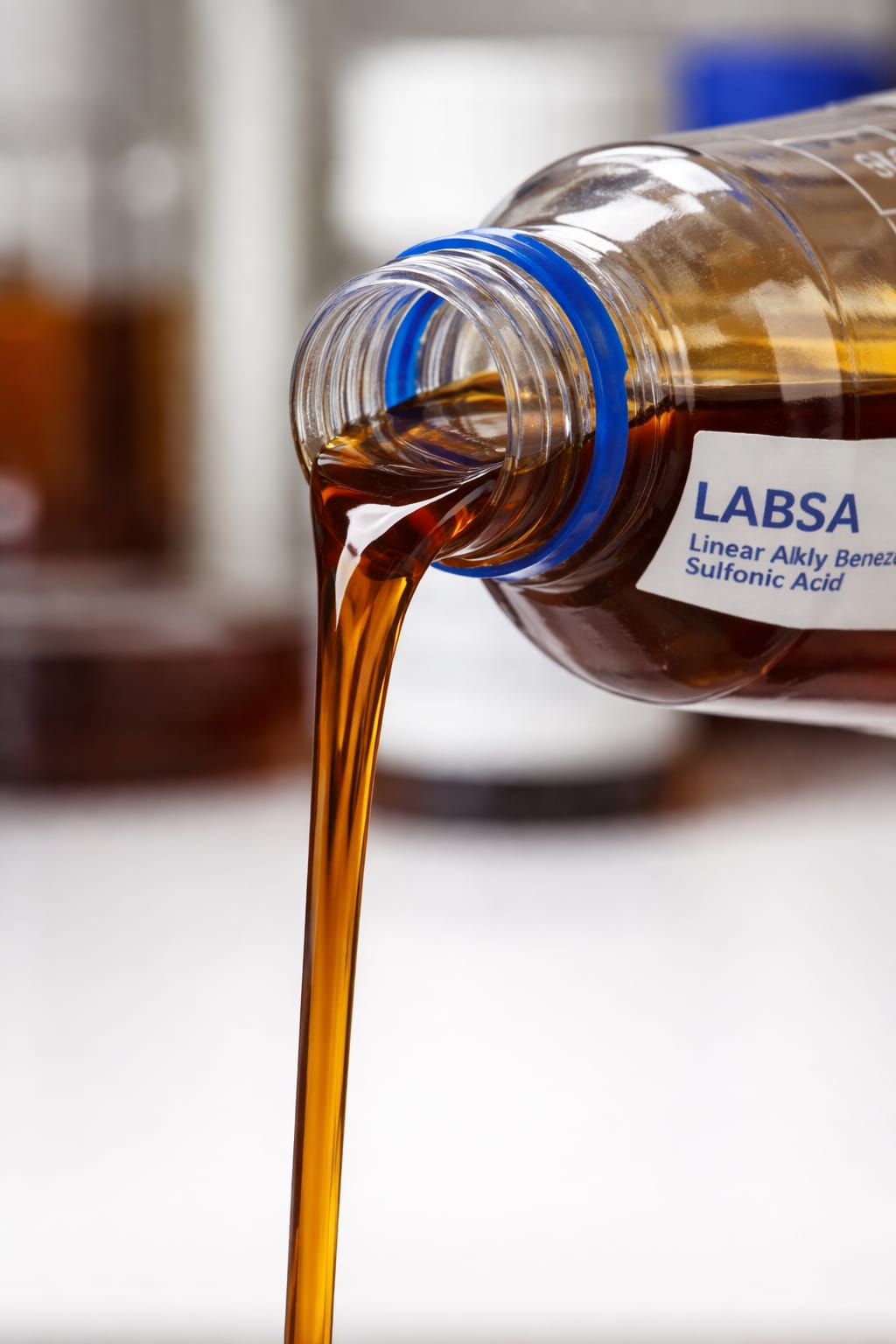
LABSA stands for Linear Alkyl Benzene Sulfonic Acid. It is a major synthetic surfactant and one of the most widely used industrial chemicals in the world, primarily due to its low cost, good performance, and biodegradability.
Chemical properties
| Property | Description |
| Appearance | Brown to dark brown viscous liquid |
| Odor | Characteristic pungent odor |
| State | Liquid |
| Consistency | Thick, viscous |
| Density | ~1.03–1.06 g/mL |
| Solubility in water | Soluble |
| Solubility in solvents | Soluble in alcohol |
| Hygroscopic nature | Hygroscopic |
| Freezing point | Low (remains liquid at room temperature) |
| Volatility | Non-volatile |
Uses
LABSA is a key ingredient in the formulation of a vast range of cleaning products. Its applications include:
Detergents: It is the primary active ingredient in many household detergents, Dishwashing liquidsAll-purpose cleaners Car washes
Industrial Cleaners: Its powerful detergency is used in industrial settings for Degreasers for machinery and equipment ,Metal cleaning
Textile Industry: LABSA acts as a wetting agent, a washing agent, and an emulsifier in various stages of textile processing, helping dyes and chemicals penetrate fabrics more effectively.
Agriculture: It is used as an emulsifier for agricultural herbicides.
Other Applications: LABSA is also used in emulsion polymerization and in the production of other chemical formulations.
Grades
LABSA (Linear Alkyl Benzene Sulfonic Acid) is primarily available in two main grades, which are defined by their active matter content:
LABSA 96%: This is the most common and widely used grade. It is a highly concentrated, viscous liquid with a minimum active matter content of 96%. This high purity makes it ideal for large-scale industrial use and for manufacturers who want to formulate their own cleaning products from scratch.
LABSA 90%: This grade has a minimum active matter content of 90%. It is essentially a pre-diluted version of LABSA 96%. This lower concentration makes it easier and safer to handle for manufacturers of household and institutional cleaners who may not need the full concentration or who have simpler formulation processes.
Key Differences and Specifications
The different grades of LABSA primarily relate to its purity, which is determined by the percentage of active matter. Other key specifications that vary slightly between grades and manufacturers include:
Active Matter (%): This is the most crucial parameter, as it defines the grade. It represents the percentage of the actual sulfonic acid in the product.
Free Oil (%): This refers to the unsulfonated organic matter. Lower free oil content indicates a purer product.
Inorganic Acid (%): This measures the content of unreacted sulfuric acid (H2SO4) left over from the production process. A lower percentage is generally preferred.
Color (Klett): The color of LABSA is measured using a Klett scale. A lower Klett value indicates a lighter, purer product.
Appearance: LABSA is a brownish viscous liquid. Its viscosity and specific gravity can vary depending on the active matter content.
The choice between a 96% and 90% grade of LABSA depends on the specific application and the manufacturing process. While the 96% grade offers higher concentration and thus requires less volume for a given formulation, the 90% grade is often preferred for its easier and safer handling.


Reviews
There are no reviews yet.