

Description
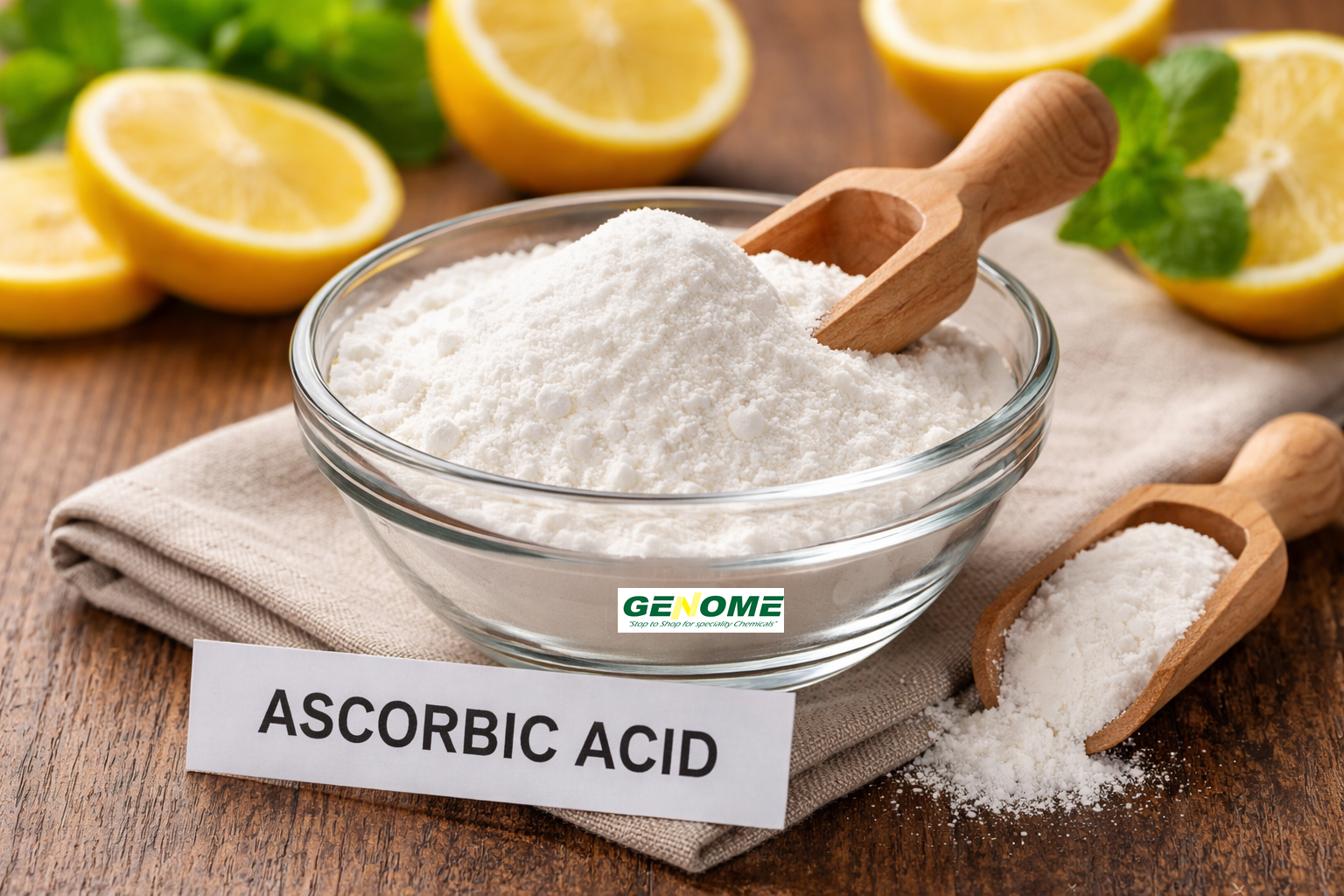
Ascorbic acid is the chemical name for vitamin C, a water-soluble vitamin essential for human health. It’s a powerful antioxidant that protects cells from damage and is vital for several bodily functions. Since the human body can’t produce ascorbic acid, it must be obtained through diet or supplements.Ascorbic acid is abundant in a wide variety of fruits and vegetables. Cooking or prolonged storage can reduce its content, so eating raw produce is often the best way to get it.Some of the best dietary sources include:
- Citrus Fruits: Oranges, lemons, grapefruit, and limes.
- Berries: Strawberries, blackcurrants, and raspberries.
- Vegetables: Bell peppers (especially yellow and red), broccoli, Brussels sprouts, cauliflower, and leafy greens.
- Other Fruits: Kiwi, papaya, cantaloupe, and mango.
- Potatoes and tomatoes are also notable sources.
Chemical Properties
| Property | Details |
| Chemical Name | Ascorbic Acid |
| Common Name | Vitamin C |
| Chemical Formula | C₆H₈O₆ |
| Molar Mass | 176.12 g/mol |
| Chemical Class | Organic acid (lactone) |
| Appearance | White to off-white crystalline powder |
| Odor | Odorless |
| Taste | Strongly acidic |
| pH (5% aqueous solution) | ~2.1–2.6 |
| Solubility in Water | Freely soluble |
| Solubility in Alcohol | Slightly soluble |
| Solubility in Organic Solvents | Practically insoluble |
| Acid Strength (pKa₁) | ~4.1 |
| Reducing Properties | Strong reducing agent |
| Oxidation Behavior | Easily oxidized to dehydroascorbic acid |
| Stability | Unstable in air, light, heat, and alkaline conditions |
| Melting Point | ~190–192 °C (decomposes) |
| Hydrolysis | Stable in acidic solutions |
| Reactivity with Metals | May react with iron and copper |
| Oxidizing / Reducing Nature | Reducing agent |
| Hygroscopic Nature | Slightly hygroscopic |
| CAS Number | 50-81-7 |
Functions and Health Benefits
Ascorbic acid plays a crucial role in many processes throughout the body. Its primary functions and benefits include:
Antioxidant Properties: As a potent antioxidant, it helps protect your cells from damage caused by harmful molecules called free radicals. This protection can help reduce the risk of chronic diseases such as heart disease and certain cancers.
Collagen Synthesis: Ascorbic acid is a required cofactor for the production of collagen, a vital protein for building and maintaining healthy skin, cartilage, tendons, bones, and blood vessels.
Wound Healing and Tissue Repair: It’s essential for healing wounds and forming scar tissue due to its role in collagen production.
Immune System Support: It helps bolster the immune system by aiding in the production and function of white blood cells.
Iron Absorption: It significantly enhances the absorption of non-heme iron, the type of iron found in plant-based foods.
Ascorbic acid mesh size
It refers to the particle size of ascorbic acid powder, which is a key physical characteristic for different applications, particularly in the food and pharmaceutical industries. Mesh size is a measurement system that indicates how fine or coarse a powder is, based on the size of the sieve openings it can pass through. A higher mesh number corresponds to a finer powder with smaller particles. common mesh sizes are:
100 mesh: A common grade for ascorbic acid powder, meaning that at least 99% of the powder can pass through a sieve with 100 openings per linear inch. The particle size is approximately 150 μm.
20 to 80 mesh: This is considered a fine granular
325 mesh: This is an ultra-fine powder grade, indicating a very fine particle size.
The appropriate mesh size is selected based on its intended use:
Fine Granular Powders: These are often used in food and beverage production, such as for fortifying juices or cereals, where easy solubility and uniform distribution are desired.
Ultra-Fine Powders: The smaller particle size of these powders is beneficial for applications where a rapid reaction or greater surface area is needed, such as in certain pharmaceutical formulations or cosmetic products. The smaller particles can dissolve more quickly and may be easier to incorporate into creams or suspensions.


Reviews
There are no reviews yet.