

Description
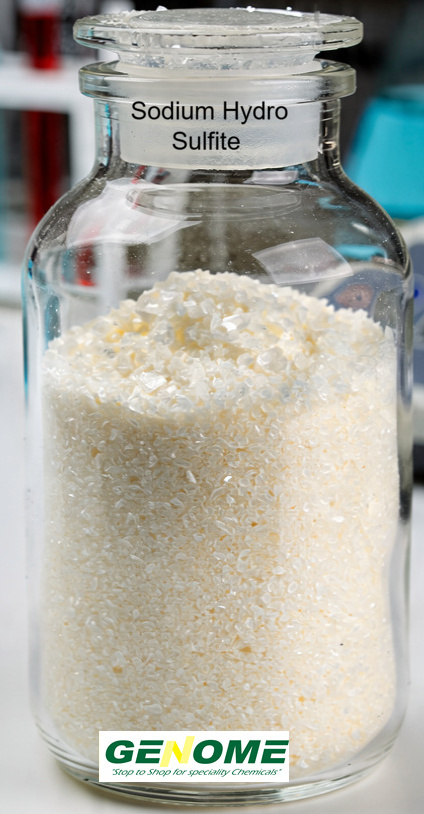
Sodium hydrosulfite, also known as sodium dithionite, is a white to grayish crystalline powder with the chemical formula Na2S2O4. It is a powerful reducing agent, meaning it readily donates electrons to other substances.
Key Characteristics and Uses
| Property | Details |
| Chemical Name | Sodium Dithionite |
| Chemical Formula | Na₂S₂O₄ |
| Molar Mass | 174.11 g/mol (anhydrous) |
| 210.15 g/mol (dihydrate) | |
| Appearance | White to grayish crystalline powder or light-lemon colored flakes |
| Odor | Faint sulfurous smell |
| Density | 2.13 g/cm³ (anhydrous) |
| 1.58 g/cm³ (dihydrate) | |
| Melting Point | 52 °C (dihydrate) |
| Boiling Point | Decomposes before boiling |
| Solubility in Water | Highly soluble (≈250 g/L at 20 °C) |
Industrial applications.
Textile Industry : It’s a key ingredient for vat dyeing, where it reduces water-insoluble dyes (like indigo) into a soluble form that can be absorbed by fabric fibers. It’s also used to strip color from dyed fabrics and as a bleaching agent for textiles and paper pulp.
Pulp and Paper : It is used to bleach wood pulp, giving paper a brighter, whiter appearance.
Other Applications: It serves as a decolorizing agent in various industries, including food, leather, and photography. It is also used in water treatment to remove iron stains and as an oxygen scavenger.
Grades of Sodium hydro Sulfite
Technical Grade
Technical grade is the most common form of sodium hydrosulfite. It’s used for industrial applications where the highest purity isn’t essential. It typically has a purity ranging from 85% to 90% or higher, with specific sub-grades like 85%, 88%, and 90% being common.
Uses: This grade is the workhorse in industries like textiles, pulp and paper, and water treatment.
Textiles: It’s a powerful reducing agent for vat dyeing, and it’s used to strip color from fabrics.
Pulp and Paper: It serves as a bleaching agent to whiten wood pulp.
Other: It’s also used to remove iron stains and as an oxygen scavenger.
Food Grade
Food grade sodium hydrosulfite is manufactured to stricter purity standards to ensure it is safe for consumption-related uses. It is often labeled as a food additive and must comply with international standards for heavy metals and other impurities.
Uses: This grade acts as a bleaching agent and preservative in the food industry.
Food Processing: It’s used to bleach and preserve a variety of foods, including dried fruits, sugar, glucose, and vegetables.
Appearance: It helps maintain the color and appearance of processed foods, preventing browning

Reviews
There are no reviews yet.