
Description
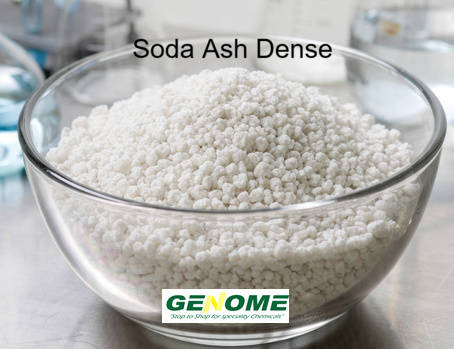
Soda ash dense is the trade name for sodium carbonate (Na2CO3), a white, odorless, granular powder. It is a vital industrial chemical distinguished from its “light” counterpart by its higher bulk density and larger particle size. This makes it less dusty, easier to handle, and more suitable for specific industrial processes.
Chemical Properties of Soda Ash Dense
| Property | Value / Description |
| Appearance | White, odorless, granular solid |
| Odor | Odorless |
| pH (1% solution) | ~11.4 (alkaline) |
| Solubility in water | ~212.5 g/L at 20 °C (high solubility) |
| Solubility in alcohol | Insoluble |
| Reactivity | Reacts with acids to release CO₂ |
| Melting point (decomposition) | ~851 °C (decomposes, does not melt cleanly) |
| Boiling point | Not applicable (decomposes before boiling) |
| Decomposition products | Sodium oxide (Na₂O) and carbon dioxide (CO₂) |
| Hygroscopicity | Slightly hygroscopic; absorbs CO₂ and moisture from air |
| pKa (of carbonate ion) | 10.33 (second dissociation of H₂CO₃) |
| Chemical stability | Stable under dry, cool conditions |
| Incompatibilities | Strong acids, fluorine, phosphorus pentoxide, aluminum (under certain conditions) |
Uses
Soda ash dense is a strong alkali, soluble in water, which allows it to be used in various applications to adjust pH levels. Its key properties and main applications include:
Glass Manufacturing: This is the largest use of soda ash dense. It acts as a fluxing agent, lowering the melting temperature of silica (sand), which reduces energy consumption and makes the glass easier to shape. It also improves the chemical durability and clarity of the finished glass.
Chemical Manufacturing: It’s a raw material for producing other sodium-based chemicals, such as sodium bicarbonate (baking soda) and sodium silicates.
Water Treatment: It’s used to raise the pH of acidic water and soften hard water by precipitating calcium and magnesium ions.
Detergents and Soaps: It functions as a water softener and a cleaning agent, improving the efficiency of surfactants.
Pulp and Paper: Used to control the pH during the pulping process, which helps with fiber bonding and paper strength.
Grades of Soda Ash Dense
Technical Grade: This is the most common and widely used grade of soda ash dense. It typically has a high sodium carbonate content of 99.2% to 99.6% minimum. This grade is suitable for the majority of industrial applications, including:
Glass Manufacturing: Its low levels of impurities like chlorides and iron are critical for producing high-quality, clear glass without defects.
Detergents and Soaps: It acts as a builder and water softener, improving the cleaning efficiency of detergents.
Chemical Production: It serves as a raw material for producing other sodium-based chemicals.
High Purity Grade: This grade is a step above technical grade, with a purity of over 99.8%. It undergoes additional purification steps to remove impurities such as calcium, magnesium salts, and organic compounds. This higher-purity material is used in applications where even small amounts of contaminants can be detrimental, such as in the production of specialized chemicals.
Food Grade: This is the highest purity grade of soda ash dense. It is certified to meet the standards of the Food Chemical Codex (FCC), ensuring it is safe for use in food-related applications. While soda ash dense is not as common as soda ash light in the food industry, this grade is used where the material’s properties are specifically required and where direct or indirect contact with food is involved.


Reviews
There are no reviews yet.