

Description
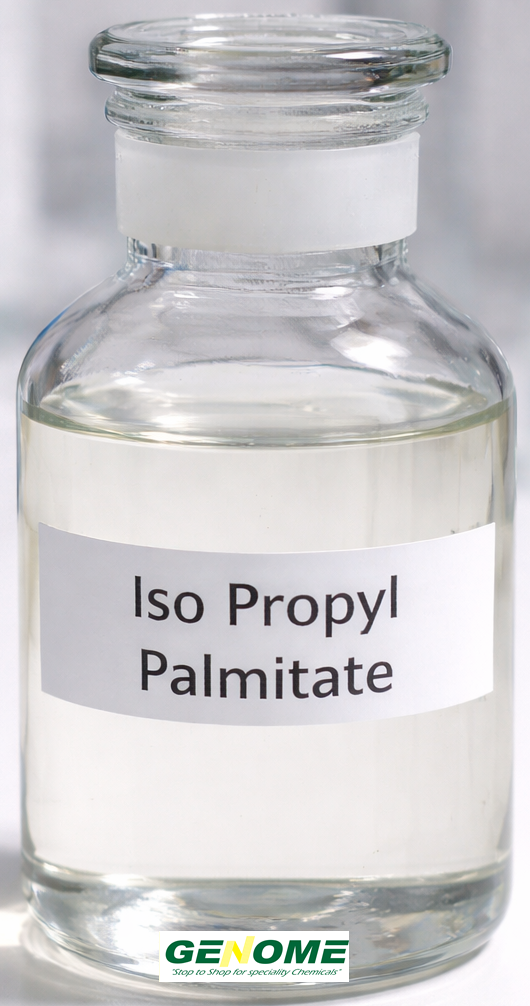
Isopropyl palmitate is a chemical compound that is the ester of isopropyl alcohol and palmitic acid. It’s a clear, colorless, and almost odorless liquid with a low viscosity. Soluble in oils, alcohols (ethanol, isopropanol), and organic solvents like acetone and benzene. It is often produced from vegetable oils (like palm oil) and is widely used in various industries.
Chemical Properties
| Property | Description |
| Chemical name | Isopropyl palmitate |
| Molecular formula | C₁₉H₃₈O₂ |
| Appearance | Clear, colorless to pale yellow oily liquid |
| Odor | Practically odorless |
| Texture | Smooth, non-greasy |
| State | Liquid |
| Density | ~0.85 g/mL (25 °C) |
| Melting point | ~−5 to −10 °C |
| Boiling point | High (decomposes before boiling) |
| Solubility in water | Insoluble |
| Solubility in solvents | Soluble in oils, alcohol, ether |
| Viscosity | Low |
| Volatility | Non-volatile |
Uses
Emollient and Moisturizer: It is primarily used as a skin conditioning agent. It acts as a lubricant on the skin’s surface, creating a smooth, soft feel and forming a protective barrier that reduces water loss.
Thickening Agent: It is used in many products to improve texture and consistency, making them feel less greasy and more elegant.
Solvent and Carrier: It helps dissolve other ingredients, particularly those that are not water-soluble, and can enhance the absorption of active ingredients into the skin.
Binder: In pharmaceutical formulations, it can be used to bind dry powder mixtures together for creating tablets.
Anti-static Agent: It has slight anti-static properties, which can be useful in certain product formulations.
Fragrance Enhancer: It can be used to improve the diffusion and longevity of fragrances.
Grades
Cosmetic Grade : This is the most common and widely available grade of Isopropyl Palmitate. It is manufactured to meet the standards required for personal care and cosmetic products.Cosmetic grade IPP has a high level of purity, but it may not be as strictly controlled as a pharmaceutical grade. It is typically free from impurities that would be harmful in skin, hair, and makeup products.It is primarily used for its emollient, solvent, and texture-enhancing properties in creams, lotions, sunscreens, and makeup.
Pharmaceutical (or NF/USP) Grade This grade is specifically manufactured for use in drug products and medical preparations. The acronyms NF (National Formulary) and USP (United States Pharmacopeia) indicate that the substance meets the stringent quality and purity standards outlined in these pharmacopeias.Pharmaceutical grade IPP is held to a much higher standard of purity and consistency. It must contain a minimum assay of the active compound and have a very low level of impurities, as specified in the relevant monograph (e.g., USP or EP). In pharmaceuticals, it serves as a non-greasy base for topical medications, a solvent for active pharmaceutical ingredients (APIs), and a penetration enhancer to improve the absorption of drugs through the skin.
Food Grade In some cases, IPP can be produced as a food-grade ingredient. This means it meets the safety and purity requirements for use in food products, such as in certain flavors or as a processing aid.This grade must be free of any substances that would be considered unsafe for human consumption.While not a common food ingredient, it can be used as a solvent or carrier for food flavors and fragrances.
Technical Grade This is a lower-purity grade of IPP.Purity: Technical grade IPP is not intended for use in products that are applied to the body or consumed. It may contain higher levels of impurities compared to other grades. Its uses are generally in industrial applications where a high level of purity is not necessary, such as a lubricant, a solvent in cleaning products, or in other non-cosmetic or non-pharmaceutical chemical processes


Reviews
There are no reviews yet.