

Description
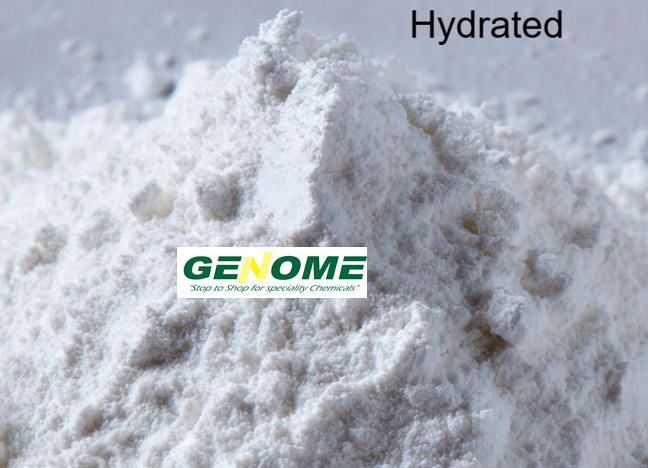
Hydrated lime, also known as calcium hydroxide, slaked lime, or builders lime, is an inorganic compound with the chemical formula Ca(OH)2. It is a dry, white, crystalline powder with a strong alkaline (basic) nature.
Chemical properties
| Property | Details |
| Product Name | Hydrated Lime |
| Chemical Name | Calcium Hydroxide |
| Chemical Formula | Ca(OH)₂ |
| CAS Number | 1305-62-0 |
| Appearance | White, fine powder |
| Odor | Odorless |
| Molecular Weight | 74.09 g/mol |
| Bulk Density | ~0.4–0.6 g/cm³ |
| True Density | ~2.21 g/cm³ |
| Solubility in Water | Slightly soluble (~1.7 g/L at 20 °C) |
| Solubility in Acids | Readily soluble |
| pH (saturated solution) | ~12.4–12.6 at 25 °C |
| Melting Point | Decomposes above ~580 °C (to CaO and H₂O) |
| Boiling Point | Not applicable (decomposes) |
| Particle Size | Fine powder (typically < 150 µm) |
| Color | White |
| Hygroscopicity | Slightly hygroscopic |
| Stability | Stable under dry conditions |
Uses
Construction: This is one of the most significant uses of hydrated lime. It is added to mortar, plaster, and stucco to improve their workability, plasticity, and strength. It is also used in soil stabilization for roads and building foundations to improve the soil’s load-bearing capacity.
Water and Wastewater Treatment: Hydrated lime is used to adjust the pH of water, soften it by removing hardness ions (calcium and magnesium), and as a flocculant to help remove suspended solids and impurities.
Flue Gas Treatment: In power plants and industrial facilities, it is used to neutralize acidic gases, such as sulfur dioxide, from exhaust streams, reducing air pollution.
Agriculture:
Soil Amendment: Farmers use hydrated lime to reduce soil acidity, or “sweeten” the soil. This raises the pH, which improves nutrient availability for plants, leading to healthier crops and increased yields.
Disinfection: It is also used to disinfect animal bedding in barns and poultry houses.
Industrial Processes:
Steel Manufacturing: Hydrated lime is used to remove impurities from steel in the refining process.
Chemical Manufacturing: It serves as an alkali source in the production of various chemicals, including calcium salts.
Sugar Refining: It is used to purify sugar cane juice by precipitating out impurities.



Reviews
There are no reviews yet.