

Description
Urea, also known as carbamide, is an organic compound with the chemical formula CO(NH2)2. It is a white, crystalline, solid substance that is highly soluble in water and is the simplest organic compound containing nitrogen.
Chemical Properties
| Property | Details |
| Product Name | Urea |
| Chemical Formula | CH₄N₂O |
| CAS Number | 57-13-6 |
| Molecular Weight | 60.06 g/mol |
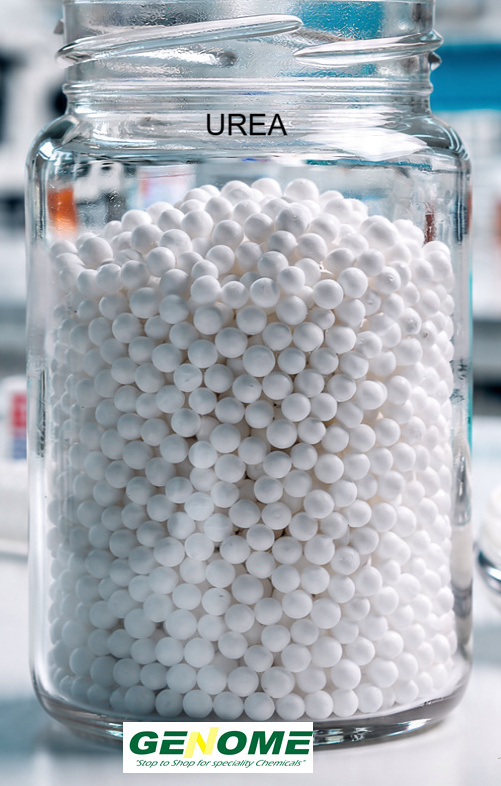
| Appearance | White crystalline solid or granules |
| Odor | Odorless |
| Taste | Slightly bitter |
| Bulk Density | ~0.72–0.77 g/cm³ (granular) |
| True Density | ~1.32 g/cm³ |
| Melting Point | 133–135 °C |
| Boiling Point | Decomposes before boiling (~152 °C) |
| Solubility in Water | Highly soluble (~545 g/L at 25 °C) |
| Solubility in Alcohol | Soluble |
| pH (10% solution) | ~7.0–7.5 |
| Hygroscopicity | Hygroscopic |
| Vapor Pressure | Very low |
| Stability | Stable under normal conditions |
Uses
Urea has a wide range of applications across several industries:
Agriculture (Fertilizer): This is the single largest use of urea, accounting for over 90% of global production. Its high nitrogen content promotes plant growth and is a crucial component of many fertilizers.
Automotive Industry: A solution of high-purity urea in water is the main component of Diesel Exhaust Fluid (DEF) or AdBlue. This fluid is injected into the exhaust stream of diesel engines to reduce harmful nitrogen oxide (NOx) emissions through a process called selective catalytic reduction (SCR).
Chemical Industry: Urea is a raw material for producing a variety of chemicals, including:
Urea-formaldehyde resins: Used as adhesives in wood products like particleboard and plywood.
Melamine: A component in plastics and laminates.
Barbiturates: A class of sedative-hypnotic drugs.
Animal Feed: Urea can be used as a protein supplement in the feed of ruminant animals like cattle and sheep.
Medicine and Cosmetics:Topical applications: Urea is an excellent moisturizer and is used in a variety of dermatological creams and ointments to treat dry, rough, or scaly skin conditions like eczema and psoriasis.
Grades of Urea
Agricultural/Fertilizer Grade Urea
This is the most common and highest-volume grade of urea. It is used as a nitrogen-rich fertilizer to promote plant growth.Purity: Typically contains about 46% nitrogen.
Impurities: The most important impurity is biuret, which is a byproduct of urea production. While some biuret is acceptable, high levels can be toxic to plants. Fertilizer-grade urea generally has a biuret content of 1.0% to 1.5% max.
Physical Form: It is available in two main forms:
Prills: Small, spherical pellets with a smooth surface, typically 1-2 mm in diameter. They are produced by dropping molten urea from the top of a prilling tower. Prills are known for their quick dissolution in water, making them suitable for liquid application or for crops that need an immediate nitrogen boost.
Granules: Larger, more durable, and often more irregularly shaped particles (2-4 mm). Granules are produced in a granulator. Their larger size and strength make them easier to handle, transport, and store, and they provide a more sustained, slow-release of nitrogen into the soil.
Technical Grade Urea (TGU)
Technical grade urea is a high-purity product used for a range of industrial applications. Higher purity than fertilizer grade, with a minimum of 99% urea content.
Impurities: It has a much lower biuret content (typically <0.9%), as well as lower levels of other impurities like moisture, formaldehyde, and various metals.
Applications:
Chemical Manufacturing: Used as a raw material for producing urea-formaldehyde resins, melamine, and other chemicals.
Adhesives: A key component in glues for the wood and furniture industry (e.g., in particleboard).
Animal Feed: Used as a protein supplement for ruminant animals like cattle.
Automotive/DEF Grade Urea
This is a very specific and high-purity form of urea used exclusively for reducing nitrogen oxide (NOx) emissions from diesel engines. Extremely high purity, often exceeding 99.5%.
Impurities: This grade has stringent limits on a wide range of impurities, especially metals, which can contaminate and damage the catalytic converter in the vehicle’s exhaust system. The biuret content is also very low (typically <0.6%).
Applications: It is the primary raw material for manufacturing Diesel Exhaust Fluid (DEF), also known as AdBlue® or AUS32. DEF is a solution of 32.5% high-purity urea in deionized water that is sprayed into the exhaust system to convert harmful NOx into harmless nitrogen gas (N2) and water (H2O).
Pharmaceutical/Cosmetic Grade Urea
This grade is purified for use in medical and cosmetic products having highest purity grade, meeting strict standards for human use.
Applications: Dermatology: Used as a powerful humectant and keratolytic agent in creams and lotions to treat dry skin conditions, such as psoriasis and eczema.
Medicine: Used in some diagnostic tests and as a diuretic.


Reviews
There are no reviews yet.