
Description
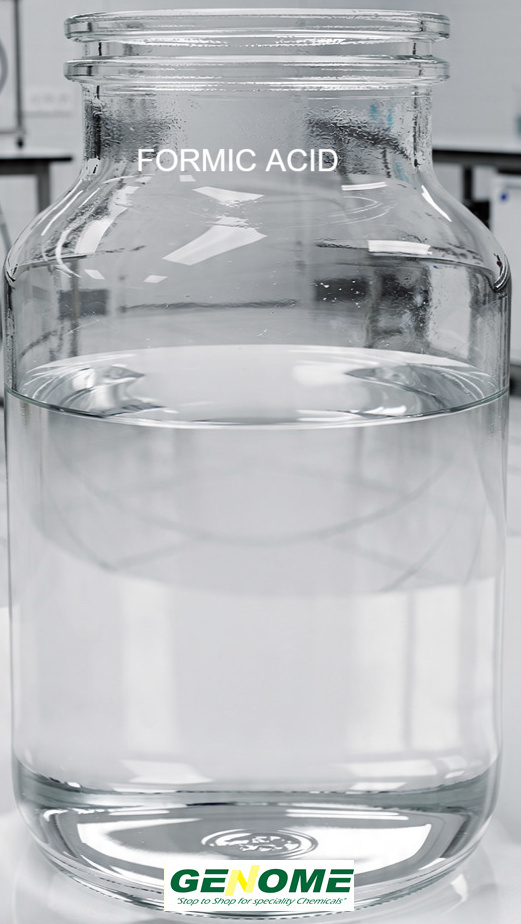
Formic acid, systematically known as methanoic acid (HCOOH or CH2O2), is the simplest of the carboxylic acids. Its name comes from the Latin word formica, meaning ant, because it was first isolated from the distillation of ants.
Chemical & Physical Properties
| Property | Description |
|---|---|
| Chemical formula | Na₃PO₄ |
| Form | Usually white, crystalline solid or powder |
| Molar mass | 163.94 g/mol (anhydrous), 212.07 g/mol (dodecahydrate) |
| Appearance | White crystalline powder or granules |
| Odor | Odorless |
| Density | Anhydrous: ~2.536 g/cm³ Dodecahydrate: ~1.62 g/cm³ |
| Melting point | ~1583°C (anhydrous) |
| Solubility in water | Highly soluble (12 g/100 mL at 25°C) |
| pH (1% solution) | ~11.5–12.5 (strongly alkaline) |
Industrial Applications: Industrially, formic acid is produced from carbon monoxide and methanol. It is widely used as a preservative and antibacterial agent in livestock feed, particularly for hay and silage, to prevent decay. It’s also used in the textile and leather industries for dyeing and tanning, and in beekeeping to control a specific type of mite.
Formic acid (HCOOH) is sold in various grades, each with a specific purity level designed for different applications. The grade of formic acid determines its concentration and the amount of impurities present, which is critical for its intended use.
Common Grades and Their Applications
Industrial/Technical Grade: This is the most common and widely used grade, typically available in concentrations ranging from 85% to 99%. The 85% concentration is especially prevalent, accounting for a significant portion of the global market. Its primary uses include:
Agriculture: As a preservative and antibacterial agent for livestock feed and silage to prevent spoilage and nutrient loss.
Textile and Leather Industries: As an acidifying agent for dyeing textiles and a tanning agent for leather processing.
Rubber Production: As a coagulant for natural latex.
Reagent Grade: With a purity of ≥95%, reagent-grade formic acid is used in laboratory settings for chemical synthesis and general analytical work. It has a higher purity than technical grade but is not as stringent as the grades used for specialized analysis.
ACS/ISO Grade: Formic acid that meets the standards of the American Chemical Society (ACS) or the International Organization for Standardization (ISO) has a high purity (often >96%) and very low levels of specific impurities. This grade is essential for applications requiring high precision and reliability, such as in quality control and research laboratories.
LC-MS/HPLC Grade: This is a very high-purity grade, often containing 98-100% formic acid. It is specifically purified for use in liquid chromatography-mass spectrometry (LC-MS) and high-performance liquid chromatography (HPLC). In these applications, even trace impurities can interfere with sensitive analyses, so this grade has strict limits on non-volatile matter and other contaminants.

Reviews
There are no reviews yet.